Why it works as a gift
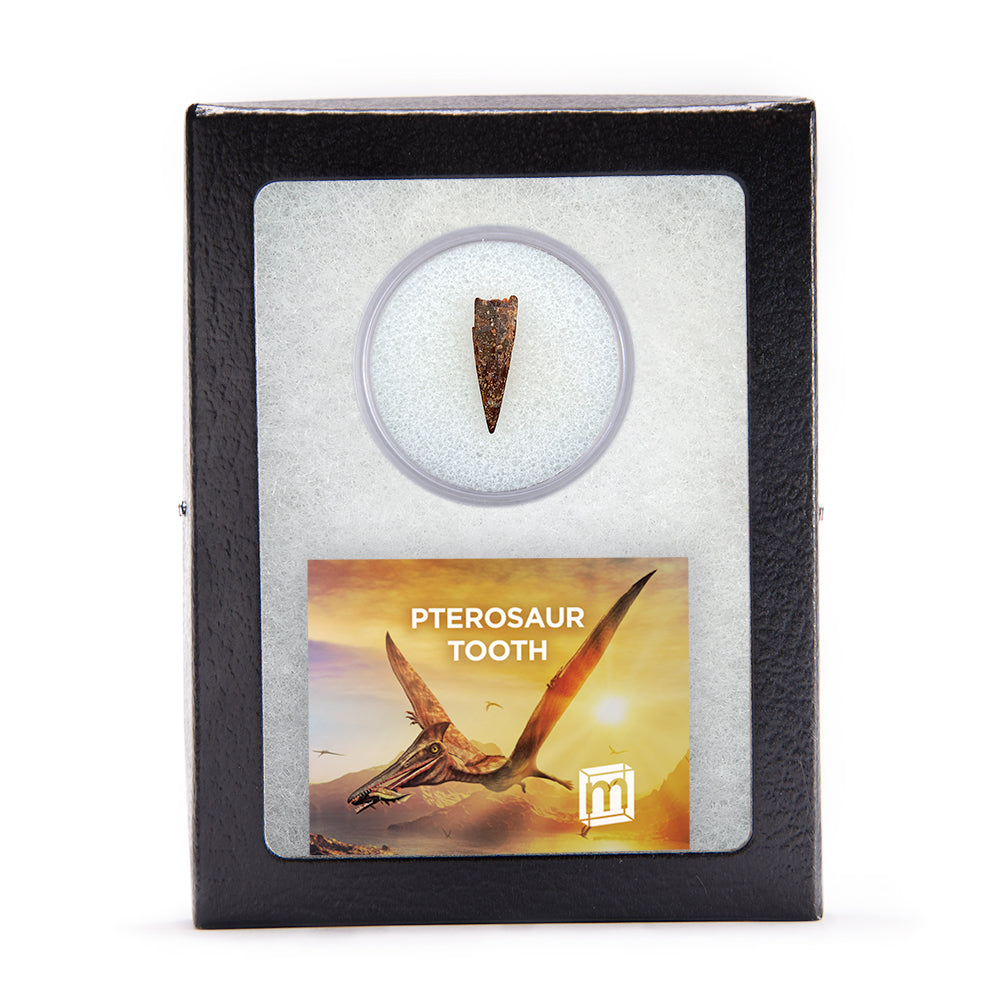
A real fossil tooth linked to a flying reptile with an estimated five-meter wingspan is a hard thing to ignore on a desk. Mini Museum's tooth comes from the Kem Kem beds of Morocco and is associated with Coloborhynchus, which the maker describes as an Early Cretaceous pterosaur. Each tooth is between 1.5 and 2.5 centimeters long and sits in an acrylic jar inside a glass-topped display box of about 4.5 by 3.5 inches, with a small information card.
It works as a gift because it is genuine natural history at an accessible size: big enough to see clearly without a magnifier, and boxed for display. It suits the grown-up who visited every natural history museum as a child, and it is equally welcome to someone who now takes their own children to them.
Be honest about the limits. Mini Museum says every tooth shows some repair, which is normal for such a delicate fossil, and that color and shape vary. The listing describes the tooth as associated with Coloborhynchus rather than identified to a species, and it gives no precise age beyond the Early Cretaceous. Compared with the Mount Everest ladder rung from the same maker, this is the pick for a natural-history fan rather than an explorer; compared with a TASCHEN book, it is something to look at every day.
The facts
- Specimen
- Individual pterosaur tooth from the Kem Kem beds, Morocco
- Association
- Coloborhynchus, an Early Cretaceous pterosaur with an estimated 5 m (15 ft) wingspan
- Size
- 1.5 to 2.5 cm (up to 2.5 cm)
- Display
- Acrylic specimen jar in a glass-topped Riker box, about 4.5 x 3.5 inches, with a small information card
- Condition
- Color and shape vary; all teeth show some repair
Shnoop hasn’t tested this product. These notes come from the maker’s and retailer’s published information, read against our gift criteria. How we pick. Sources: Mini Museum: Pterosaur Tooth.