Why it works as a gift
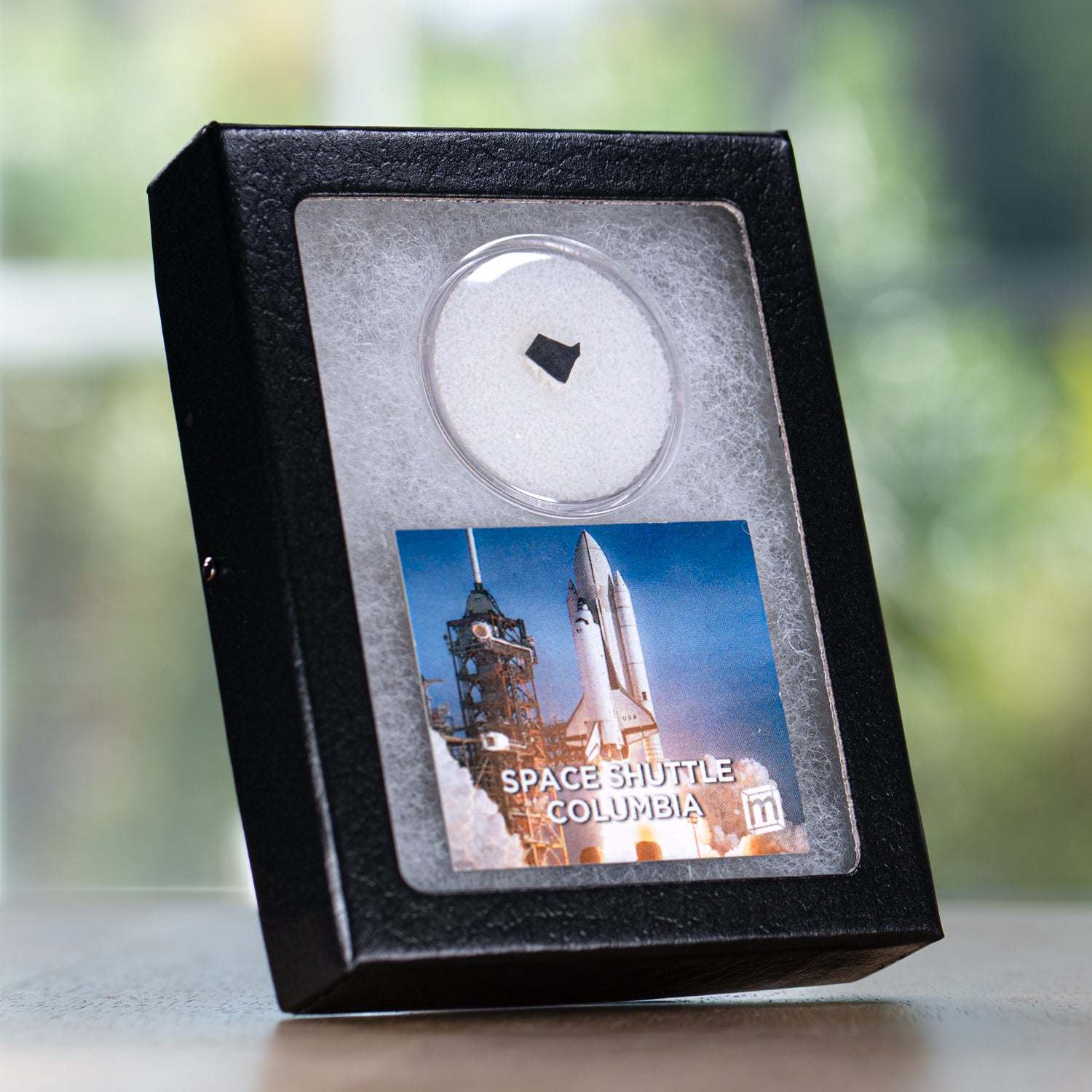
The person who already has the books, the models and the launch photos is hard to surprise. A piece of a flown spacecraft is different, because it is the thing itself rather than a picture of it. Mini Museum describes this as a fragment of the black, reaction-cured glass coating from a High-Temperature Reusable Surface Insulation tile on Columbia (OV-102). According to the NASA disposition paperwork that Mini Museum says it keeps in its collection, the tile was removed after Columbia's seventh mission, STS-61-C, which flew on January 12, 1986.
The presentation does most of the gift work. The fragment, about 4 to 5 millimeters, sits in an acrylic jar inside a glass-topped display box roughly 4 by 3 by 1 inches, with an information card that the maker says serves as the certificate of authenticity. It is small enough for a desk or a shelf.
Be clear about what it is: a tiny fragment, not a whole tile. Mini Museum notes that the silica is not stabilized and will powder under pressure, so it should stay in its jar. Compared with TASCHEN's The Making of Kubrick's 2001, which also suits a space fan, this is the object rather than the story; for a bigger gift, the Apollo 13 foil from the same maker has a stronger historical pull.
The facts
- Specimen
- Fragment of reaction-cured glass coating from a Space Shuttle Columbia (OV-102) HRSI tile
- History
- Removed after mission STS-61-C (launched January 12, 1986), per NASA disposition paperwork held by Mini Museum
- Size
- About 4 to 5 mm
- Display
- Acrylic specimen jar in a glass-topped Riker box, about 4 x 3 x 1 inches
- Included
- Information card that serves as the certificate of authenticity
- Handling
- Not stabilized; will powder under pressure; gloves recommended