Is it rude to regift? When it's fine, when it isn't, and how to pass a gift on gracefully
Passing on a gift you can't use is often kinder than letting it gather dust. The rudeness is in the execution: the wrong item, the wrong circle, or pretending you shopped for it.

By Shnoop Editors · Published 9 min read
Save on PinterestNo, regifting is not inherently rude. Passing on a new, unused gift to someone who will genuinely like it is a considerate use of something that would otherwise sit in a cupboard. It becomes rude when the item is used, personal or one-of-a-kind, when the original giver could find out and be hurt, or when you pretend you chose it.
Most of the hurt feelings around regifting come from a handful of avoidable mistakes, not from the practice itself. Below: a quick test to run before you pass anything on, the items that should never be regifted, answers to the specific questions people ask (gift cards, wine, flowers, money), and what to do with a gift you can't regift.
What does it mean to regift?
Merriam-Webster defines regift as giving someone a gift that was previously received from someone else, and dates the verb to 1995. The word may be recent, but the habit isn't: a bottle of wine brought to a dinner and opened at the next one, or a book passed to a friend who will read it, is regifting by another name.
Regifting even has its own date on the calendar. In 2008, Money Management International, a nonprofit credit counseling agency, promoted a National Regifting Day on the Thursday before Christmas as a light way to get people talking about holiday spending. It chose the date in honor of office parties and the gifts swapped at them.
When regifting is perfectly acceptable
Etiquette guidance agrees more than you might expect. The Emily Post Institute's advice sets out the conditions that make a regift fine, and they line up with common sense:
- You're certain the new recipient would really like it. Not "someone might," but this person, for a reason you could say out loud.
- It's brand new and complete. Unopened, in its original packaging, with instructions and every part.
- The original giver didn't choose it with special care and wouldn't mind seeing it passed along.
- The two people don't know each other, or wouldn't be in a position to compare notes.
- It isn't handmade or personalized. Anything monogrammed, engraved or made by the giver stays with you.
Meet all five and you aren't cutting corners. You're matching a good thing with a person who will use it, which is the whole point of giving a gift.
The two-question test
Would the person who gave it to you be hurt to see it in someone else's hands? Would the person receiving it be hurt to learn where it came from? If the honest answer to both is no, regift it. If either is yes, don't.
When regifting is rude
Reader's Digest's take on regifting puts it neatly: thoughtlessness is rude, and so is waste. The common failures are all forms of thoughtlessness:
- Regifting within the same circle. Passing a present from one friend to another in the same group, or between relatives who will both be at the same holiday table, is how regifts get discovered.
- Regifting something used or opened. A candle that has been lit, a book with a cracked spine or a perfume that has been sprayed is a cast-off, not a gift.
- Regifting the wrong thing to the wrong person. A gift you didn't want is rarely the right gift for someone else unless it suits them specifically.
- Regifting to the original giver. It usually happens months later, when nobody remembers where a scented candle came from.
- Pretending you shopped for it. The Emily Post Institute calls wrapping a regift as if you bought it inherently deceitful. You don't have to announce a regift, but don't invent a story about it.
What gifts should never be regifted?
Some gifts carry the giver with them. Passing them on doesn't just risk discovery; it discards the part of the gift that mattered.
| Type of gift | Regift? | Why |
|---|---|---|
| Sealed food, chocolate or tea, well within its date | Yes | Consumable and impersonal; check the best-before date first |
| Unopened wine or spirits | Yes, with care | Fine for a host or a drinker you know; never to the person who brought it |
| A sealed candle, soap or bath set | Yes | Only if unused and the scent suits the new recipient |
| A book still in new condition | Yes | Best with a note on why you thought of them |
| Duplicate kitchen or home items, boxed | Yes | The classic good regift: you received two |
| Gift cards with a full balance | Usually | Check the balance, expiry and fees before passing it on |
| Clothing with tags | Sometimes | Only if you know the size and taste; otherwise exchange it |
| Handmade items | No | The giver's time is the gift |
| Monogrammed or engraved pieces | No | Someone else's initials are hard to explain |
| Heirlooms and family pieces | No | Keep, or return within the family |
| Anything used, opened or worn | No | That's a hand-me-down, not a gift |
One more category to keep: anything given to mark a milestone between you and the giver, such as a wedding gift, a graduation keepsake or a present from a grandmother. Even if it isn't to your taste, its value to the giver is tied to it staying with you.
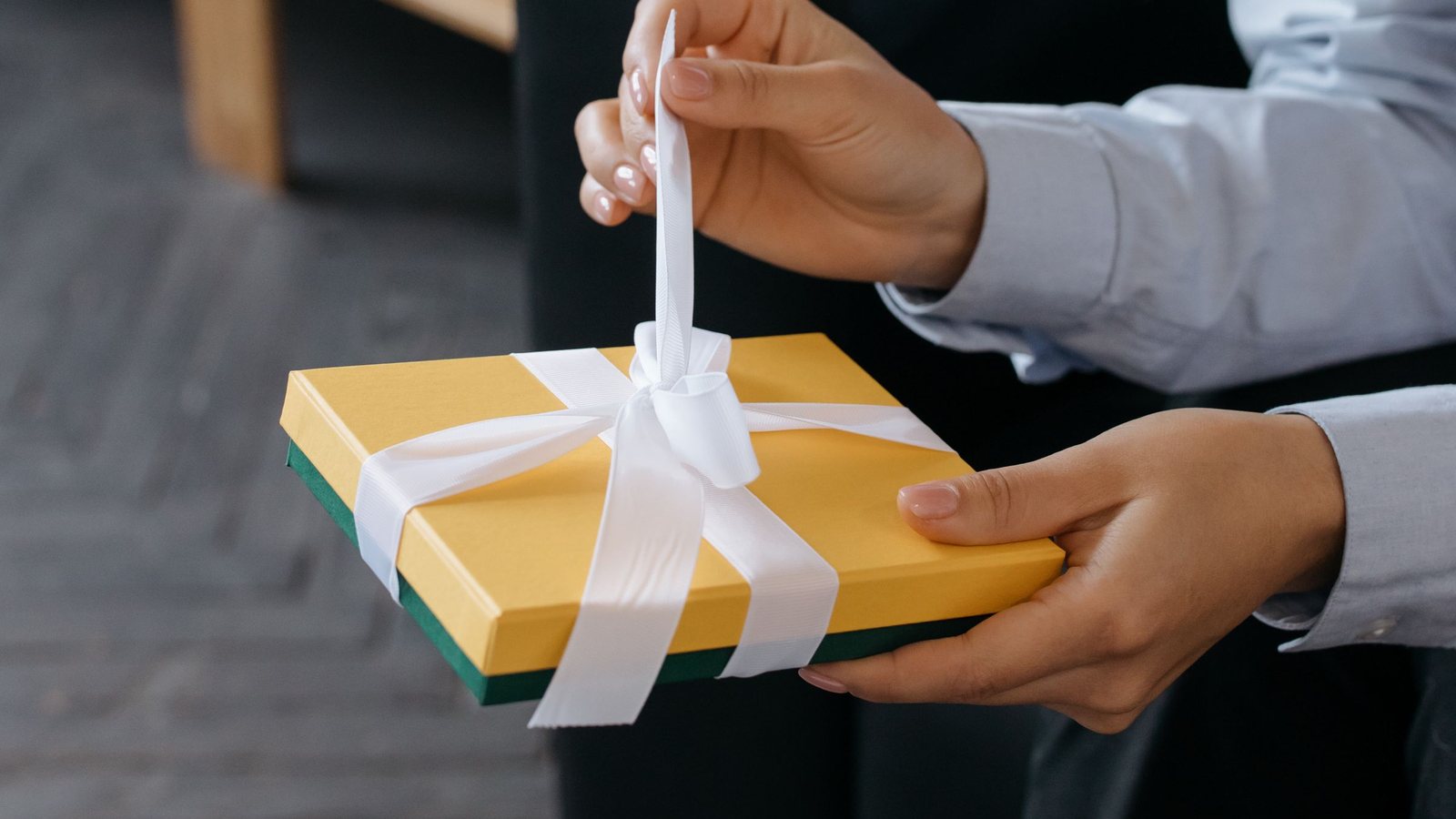
How to regift gracefully, step by step
If an item passes the test, the execution decides whether it lands as thoughtful or careless. Treat it like any gift you'd choose:
- Keep a simple record. Note who gave you what when you receive it, on your phone or a list in a drawer. It is the single best protection against giving something back to its original giver.
- Check every inch of the packaging. Remove the old gift tag, any card tucked inside the box, receipts and personal notes. Look under tissue paper and inside gift bags.
- Check the date. Chocolate, tea, coffee, skincare and anything edible should have plenty of time left before its expiration date.
- Rewrap it properly. Fresh paper or a new gift bag, not the original wrapping. Our guide to how to wrap a gift beautifully covers the basics.
- Add a card in your own words. Say why you thought of them, not where the item came from.
- Give it for a reason. A hostess gift, a thank-you, a birthday present for someone whose taste fits; the occasion should suit the item.
Should you tell someone their gift was regifted?
You don't have to, and with a sealed item nobody expects you to. But honesty is often the most graceful route. The Emily Post Institute calls this a thoughtful pass-along, and its example is as simple as "Ellie, I received two copies of this book and want you to have one." Said plainly, it reads as generous, not cheap, and it removes any risk of being caught out later.
Openness works especially well between close friends and family, where everyone already swaps books, kitchen tools and duplicate presents. It works less well for formal occasions such as a wedding, a work gift or a host you're meeting for the first time, where a regift should simply be a good, new gift with nothing to explain.
How to handle discovering a regift
If you discover that someone regifted something you gave them, or you receive a gift with someone else's card still inside, the gracious response is to let it pass. The person chose to give it to someone who would use it, which is what you wanted for it too. If a close friend mentions it, a light "I'm glad it found a good home" ends the conversation kindly.
You don't have to announce a regift, but don't invent a story about it.
Regifting gift cards, wine, flowers and money
Is it OK to regift a gift card?
Yes, if the card is unused and the store suits the new recipient. Before you pass it on, check the balance and the terms. The Consumer Financial Protection Bureau explains that under federal law a gift card can't be sold with an expiration date less than five years away, and inactivity or service fees can't be charged in its first 12 months; after that, they can start to eat into the balance. Your state may give more protection. A card that has been sitting in a drawer can still lose value, so confirm the balance first. For presentation ideas, see how to give a gift card.
Quick rule for anything with a balance
Gift cards, prepaid cards and vouchers: confirm the balance, the expiration date and any fees before you pass them on. A card that turns out to be empty is worse than no gift.
Is it OK to regift wine?
Unopened wine and spirits are among the easiest gifts to pass on. Bring a bottle you were given to a dinner party, but never to the person who gave it to you or to a host in the same circle. Check the label is clean and the bottle wasn't meant as a special vintage the giver chose with care. Our hostess gift etiquette guide covers what a host expects.
Is it rude to regift flowers?
Cut flowers don't regift well: they are perishable, they were meant for a specific moment, and a bouquet that has spent a day in your house is no longer fresh. A potted plant in good health is different, as long as you've been able to care for it and it isn't one the giver will ask about.
When is it rude to regift money?
Passing on a cash gift or a check is rude when it was given for a stated purpose, such as a wedding fund or a graduation gift toward a first apartment, or when the giver would see it as dismissing their help. Using gifted money to buy someone else a present is simply spending it, and nobody needs to know.
Better options when you can't regift
If a gift fails the test, it doesn't have to sit in a closet. Regifting is only one of several good outcomes:
- Exchange it. Many retailers accept exchanges with a gift receipt; ask the giver for one only if you know them well enough.
- Donate it. New, unused items are welcome at shelters, charity shops and community drives, especially in December.
- Use it for a swap. An office white elephant or a gift exchange among friends is the one setting where everyone knows gifts may be recycled.
- Keep it for a use, not a person. A spare candle or a box of chocolates can be a host gift on short notice, as long as it stays new.
And if you're the one shopping, the easiest way to keep your own gifts out of the regift pile is to choose with a specific person in mind. Our guide to how to choose a gift for someone who has everything walks through how to do that.
The Shnoop Letter
Want the next guide first?
New gift guides and seasonal picks, sent now and then — and our free Gift Planner (PDF) as a thank-you. Unsubscribe anytime.
We use your email only for this newsletter. See our privacy policy.
Questions readers ask
Is it rude to regift a present?
Not if it's new, unused and a genuine fit for the person receiving it, and the original giver wouldn't be hurt to learn of it. It is rude to regift something used, personalized or handmade, to pass a gift around the same circle of friends, or to give it back to the person who gave it to you.
Is it bad luck to regift?
No. None of the etiquette sources we checked, including the Emily Post Institute and Reader's Digest, treat regifting as bad luck, and we found no established superstition attached to it. The real risk is social: the person who gave you the gift finding out. Keep a record of who gave you what, keep the two circles apart, and luck doesn't come into it.
What is it called when you regift?
It's simply called regifting, and someone who does it is sometimes called a regifter. Merriam-Webster defines the verb as giving someone a gift you previously received from someone else and dates its first known use to 1995; the noun, meaning the passed-on gift itself, follows in 1998.
Is returning a gift disrespectful?
Not when it's done quietly and the item genuinely doesn't work for you, such as the wrong size or a duplicate. Avoid asking the giver for a receipt unless you're close, and never return a handmade or personalized gift. An exchange that turns it into something you'll use is often what the giver would want.
Keep reading
- How to give a gift card that doesn't feel impersonal: choosing the card, what to write and how to present itA gift card feels thoughtful when it is the right card, comes with a sentence about why, and arrives looking like a gift. Here is how to do all three, and how to keep the money safe.
- Hostess gift etiquette: what to bring, how much to spend, and when to give a host giftWhen a host gift is expected and when it isn't, what to bring to a dinner party, a weekend stay or a shower, how much to spend, what to leave at home, and the thank-you that matters more than any of it.
More from the Journal
Sources
- Emily Post Institute: Regifting, tips to avoid hurt feelings
- Merriam-Webster: regift (definition and first known use, 1995)
- Reader's Digest: Is it really rude to regift a present?
- Consumer Financial Protection Bureau: Giving or receiving gift cards? Know the terms and avoid surprises
- Money Management International: Happy National Regifting Day (December 18, 2008)
Written by Shnoop Editors; product facts are checked against the maker’s or retailer’s own pages. Read how we pick, or tell us about a mistake.