Why it works as a gift
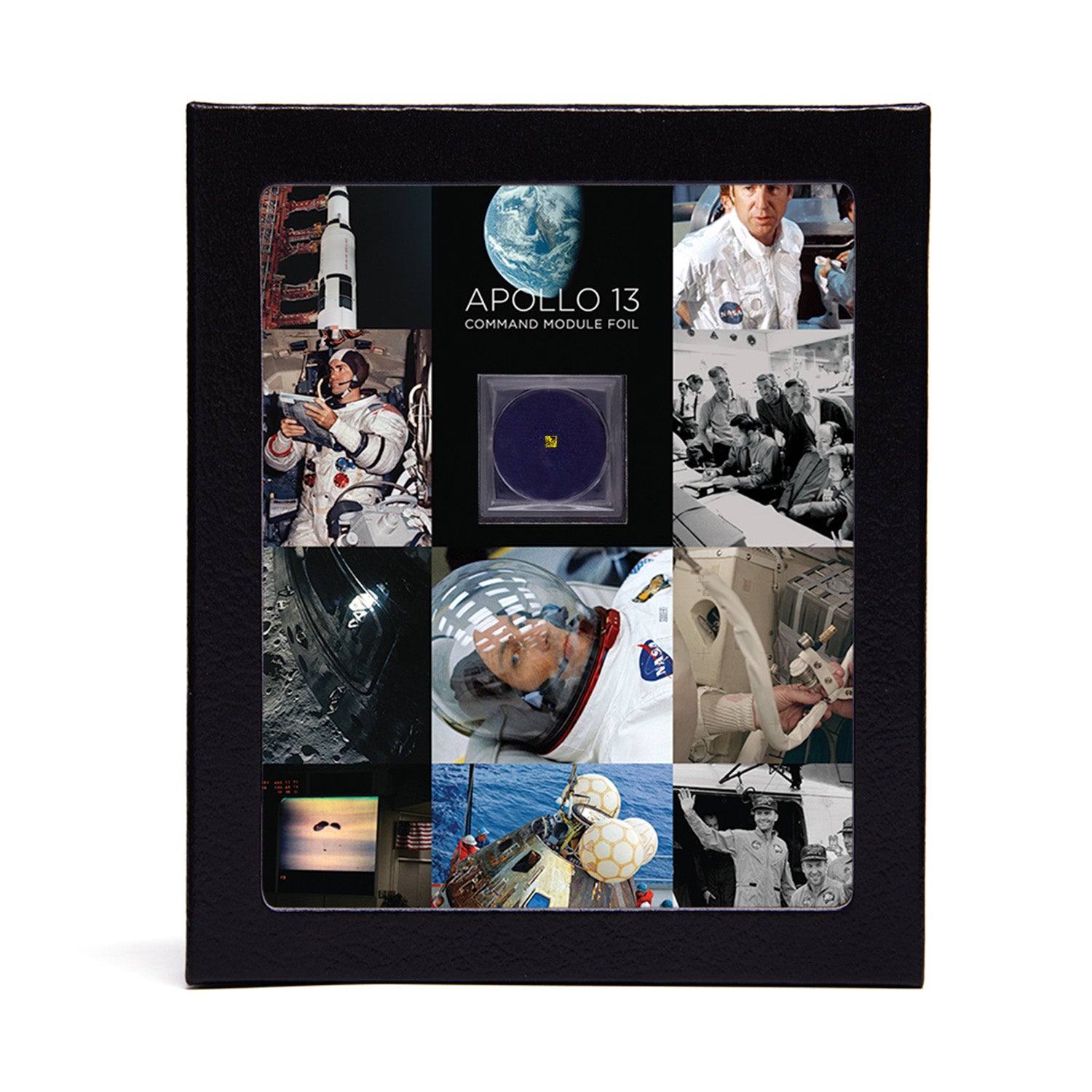
Apollo 13 is the mission most people know even if they know nothing else about spaceflight, and that makes a flown piece of it unusually personal for the right person. Mini Museum describes this as mission-flown Kapton foil, an aluminized polyimide film that formed part of the thermal protection around the command module that carried Lovell, Swigert and Haise. This Medium size is about 2 by 2 millimeters.
The presentation is more elaborate than Mini Museum's smaller specimens. The fragment sits gold side out in an acrylic cube with a magnifying lid, inside a padded, glass-topped display case of about 5.5 by 6.5 inches. An information card with mission images and details doubles as the certificate of authenticity, and it is die-cut to hold the cube so it can be displayed four ways. Mini Museum says the material came from the collection of a retired NASA production control engineer who oversaw command module decommissioning.
The trade-off is scale: it is a speck you view through a lens. The same foil is sold in a 1 mm square for a much smaller gift, but at that size it is hard to appreciate. Compared with the Columbia tile fragment, this has the stronger story; compared with a practical gift at the same budget, such as Nikon's Monarch M7 binoculars, it is a single object with a direct link to a real event, kept for meaning rather than use.
The facts
- Specimen
- Mission-flown Kapton foil from the Apollo 13 command module
- Size
- About 2 x 2 mm (Medium)
- Display
- Acrylic cube with magnifying lid in a padded, glass-topped Riker case, about 5.5 x 6.5 inches
- Included
- Information card with mission details that serves as the certificate of authenticity
- Provenance
- From the collection of retired NASA Production Control Engineer William R. Whipkey, acquired at auction, per Mini Museum
- Other sizes
- Also sold as a Small (1 x 1 mm)